A language model running on ambiguous contracts will reveal measurable ambiguity at scale. In US health care, that is not a limitation, Rather, it is the most interesting thing to happen to healthcare administration in my career. Hmmm… that is not a sentence I could have ever imagined constructing.
My recent JAMA Viewpoint makes an argument that sounds technical: when payers and clinicians both hand coverage decisions to large language models, discretion does not vanish. It relocates — upstream, out of the heads of thousands of reviewers and into a handful of explicit choices about retrieval sources, thresholds, exceptions, and what the system is told to optimize. Here I want to say the part that did not fit in a Viewpoint, which is why that relocation matters.
Start with what we are actually giving up. Murk, aka institutional opacity. American medical adjudication runs on productive ambiguity. You might find a contract that points one way, a reviewer’s note that points another, a denial letter that points a third, and a family left to guess which version was doing the work. That ambiguity is not a bug the industry is straining to fix. Ashish Jha keeps pointing at the bill: we are not expensive because we use more care, we are expensive because of prices and administration. Worse, the administrative machine has metastasized. Over five decades the number of physicians roughly doubled while the number of administrators grew more than six-fold, with prior-authorization and denial-management units among the fastest-growing features of American medicine. The murk is not friction we tolerate on the way to something. For large parts of the system, the murk is the product.
A language model will run on murk but it turns it into reproducible decisions at scale. It’s training/alignment develops a function that those authoring the healthcare billing and reimbursement rules may not even be aware of. That transformation of murky written poliies into reproducible decisions at scale executed in seconds, or less, is the very thing people fear and is also the opportunity. For the first time, the values actually doing the work, even if only implicitly, are exposed by decisions for which relatively simple analyses across millions of decisions are revealing. There is no possible appear to the subtleties of human judgement because the humans adjudicating the decisions have been replaced. The large scale analyses between counterparties can be used productively. Disagreement between two instrumented systems stops being episodic and unaccountable, the way human disagreement (and, I will admit, human peer review) tends to be, and becomes reproducible: a continuous audit of the rule rather than a once-in-a-decade appellate decision. Where the models stably disagree, the rule is hiding something. That is genuinely new, and it is good.
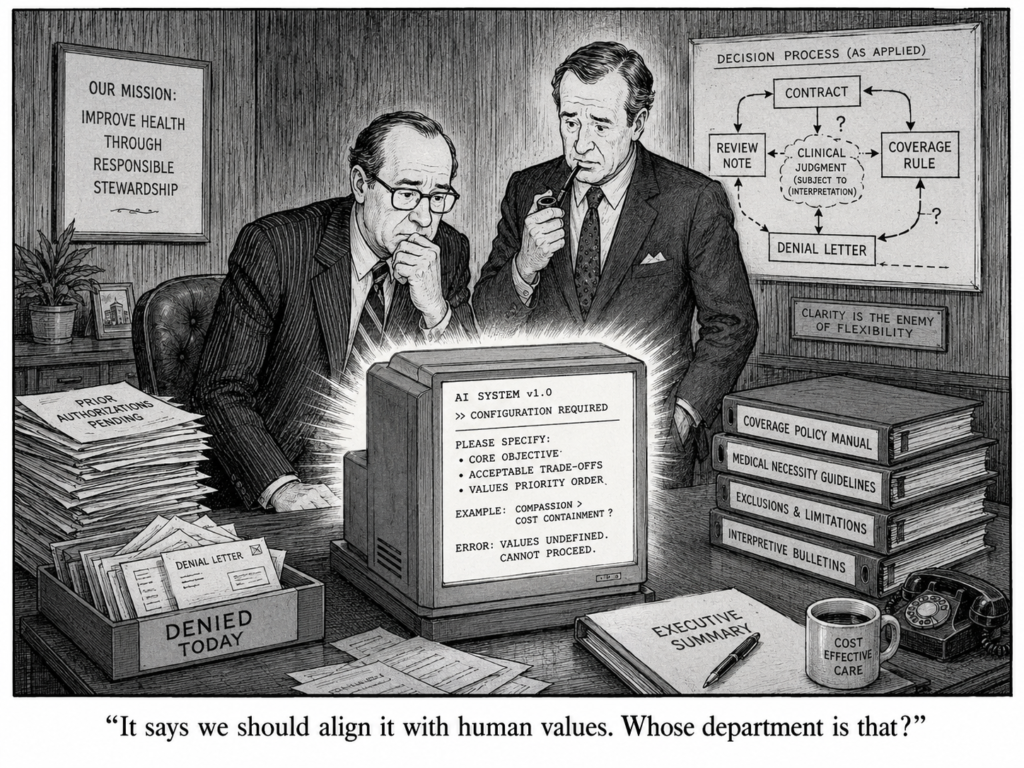
But I have watched a technology of representation get captured before. The electronic health record was sold to us as a way to optimize decisions for the individual patient; in practice it became an instrument for billing and for aligning clinicians. The wrong objective function won. Adjudication AI faces the identical fork. An explicit rule warped toward maximizing denials, executed flawlessly and at scale, is far more dangerous than ten thousand inconsistent reviewers. It will be efficient, consistent, fast, and bad for sick people. Concordance between two machines or two parties to the healthcare revenue cycle is not evidence of virtue; it reflects whatever we encoded. The cartoon I keep returning to has two executives staring at a glowing box: “It says we should align it with human values. Whose department is that?”
So here is the honest version of the opportunity. AI does not supply rationality to US health care. It can remove our ability to hide the absence of it. What it cannot do is choose the values. That part was always ours and now there is nowhere left to put it but on the page or big screen. If you have an AI startup in the revenue cycle space, this may be your opportunity to do good by making the gaps in the *interpretation* of healthcare contracts visible to the patient and to the adverserial parties. *Then* you can guide them to closing the gap to save administrative costs rather than shortchanging effective healthcare. If you are a policy maker (hint: at CMS), demand the MedLog accountability of the AI’s and convene meetings to address the contractual interpretation gaps revealed by these logs.